MNREGA Job Card 2026 — Apply Online, Check Payment Status & Wage Rates
MNREGA Job Card 2026: How to register, get a job card in 15 days, demand work, and check NREGA payment status. State-wise wage rates, MIS payment trace, and rejection fixes.

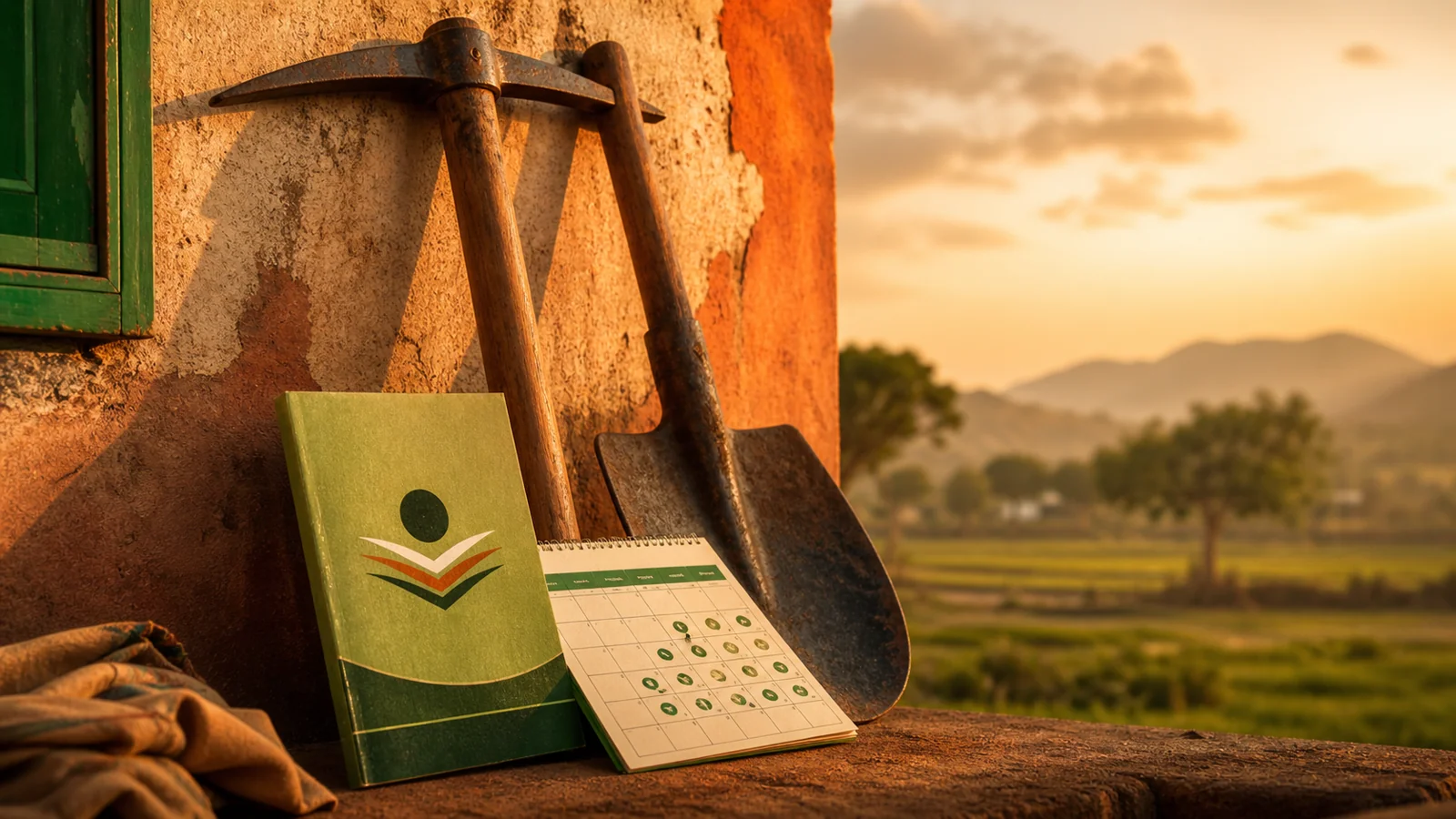
Table of Contents ▾
Quick summary. Under the Mahatma Gandhi National Rural Employment Guarantee Act (MGNREGA), every rural household in India is entitled to 100 days of unskilled wage employment per financial year. The household receives a Job Card (free, valid for 5 years) at the Gram Panchayat. Wages range ₹241–₹374 per day in 2026 depending on the state and are paid directly to the worker’s bank or post-office account within 15 days of work completion. Apply mode: Offline at the Gram Panchayat (the most reliable route) or online via state portals / nrega.nic.in.
MGNREGA is the world’s largest public-employment guarantee programme. Enacted in 2005 and operational since 2006, it makes wage employment a legal right — if work is demanded but not provided within 15 days of the demand, the worker is entitled to an unemployment allowance. As of 31 March 2026, the official MIS shows 15.4 crore active job cards, 9.7 crore individual workers registered, and 289 crore person-days of work generated in FY 2025–26.
The Job Card is the household’s identity document for the scheme. It records the names and photographs of all adult members willing to do unskilled manual work, every demand for work, every day of work done, and every wage payment. Without a Job Card, no MNREGA work can be allotted.
Scheme at a glance
| Detail | Information |
|---|---|
| Act | Mahatma Gandhi National Rural Employment Guarantee Act, 2005 |
| Ministry | Ministry of Rural Development |
| Guarantee | 100 days of unskilled wage work per rural household per year |
| Wage range (2026) | ₹241–₹374 per day (state-notified, see below) |
| Job Card validity | 5 years (renewable) |
| Cost | Free — no fee for Job Card or registration |
| Apply mode | Offline at Gram Panchayat (recommended) + state online portals |
| Official portal | nrega.nic.in |
Who is eligible?
Educational Qualification
Not applicable (no minimum)
Age Limit (As on Date of application)
18 to 120 Years
Other Requirements
- Nationality: Indian citizen
- Household must be located in a rural area (urban residents are not eligible — see urban equivalent under each state's urban employment scheme)
- Adult members (18+) of the household must be willing to do unskilled manual work
- There is no income limit, no caste filter, no land-holding ceiling — every rural household qualifies
- Migrant workers can register in their home district and demand work whenever they return
- Persons with disabilities can register and are entitled to age- and disability-appropriate work
In simple terms. If your family lives in a village (not a Census Town) and at least one adult is willing to do hard manual work — digging earth, building a check-dam, planting saplings — your household is eligible. There is no other filter.
State-wise wage rates (FY 2026–27, notified 27 March 2026)
| State / UT (sample) | Daily wage (₹) |
|---|---|
| Haryana | 374 |
| Goa | 365 |
| Kerala | 358 |
| Karnataka | 349 |
| Tamil Nadu | 319 |
| Maharashtra | 312 |
| Andhra Pradesh / Telangana | 307 |
| West Bengal / Odisha | 250 |
| Madhya Pradesh | 247 |
| Bihar / Jharkhand | 245 |
| Uttar Pradesh / Uttarakhand | 241 |
| Mizoram | 287 (highest in the North-East) |
The full state-wise notification is published at the start of each financial year on nrega.nic.in. Wages are linked to the Consumer Price Index for Agricultural Labourers (CPI-AL) and revised annually.
Documents required
While filling online form
- Aadhaar card of every adult household member you want listed on the Job Card
- One recent passport-size photograph (Gram Panchayat may also click on the spot)
- Bank or post-office account details of the primary card-holder (preferably Aadhaar-seeded)
- Residence proof — voter ID, ration card, or any utility bill in the village
- Mobile number (preferred — the MIS sends payment SMS)
How to apply for a Job Card
Method 1 — At the Gram Panchayat (most reliable)
- Walk into your Gram Panchayat office during working hours and ask for the Job Card application form (also called Form-1).
- Fill in: name of the head of household, names + ages + Aadhaar numbers of all adult members, photograph, bank/post-office details.
- Submit to the Gram Rozgar Sevak (GRS). Insist on a dated receipt — this starts the legal 15-day clock.
- Within 15 days, the Job Card must be issued. It is a small booklet with a unique Job Card number (e.g., HR-04-001-001/123) and the photographs of all listed members.
- The GRS pastes the photographs and gets the card signed by the Sarpanch / Panchayat Secretary.
Method 2 — Online via state portals
The central nrega.nic.in portal does not accept direct citizen applications. Instead:
- Go to your state’s MGNREGA portal (e.g., umang.gov.in → MGNREGA → Job Card Apply) or the JanSeva / e-District portal of your state.
- Aadhaar-OTP login → fill the same Form-1 fields → submit.
- The Gram Panchayat receives the application, runs Gram Sabha verification, and issues the card within 15 days.
⏰ Last Date: Open (registration is throughout the year, no deadline)
Find your state's MGNREGA portalClicking this button will take you to the official government portal.
How to demand work (the part most workers skip)
Having a Job Card is not enough — you must formally demand work to trigger the 100-day guarantee.
- Submit a written demand for work at the Gram Panchayat (form: Application for Employment). State the number of days demanded and dates from when.
- Insist on a dated receipt. The 15-day clock starts here.
- Within 15 days, the Panchayat must issue you a muster roll allotment — the work-site, dates, and your role.
- If no work is allotted within 15 days, you are entitled to unemployment allowance (1/4th of wage for first 30 days, 1/2 thereafter) — claim this in writing at the Panchayat.
Why this matters. Many workers receive Job Cards but never demand work formally, and so the legal 100-day guarantee never activates. The written demand is the only document that creates an enforceable right.
How to check NREGA payment status
- Open nrega.nic.in → Reports → Job Card / Employment Register.
- Pick State → District → Block → Panchayat → Year.
- The page lists every Job Card number in the panchayat. Click your number to open the Job Card e-record.
- You’ll see: each muster roll you worked on, days attended, wage rate, total wage earned, and the payment date + reference number (NEFT / APBS).
- To trace a specific delayed payment: Reports → Wage List Status → enter your Job Card number → see whether the wage list is generated, signed, or credited.
| Stage shown | What it means |
|---|---|
| Muster roll closed | Work attendance has been recorded; wage list is being prepared |
| Wage list generated | Amount calculated; awaiting Panchayat signature |
| FTO (Fund Transfer Order) sent | Money has been pushed to the bank/post office |
| Credited | Payment landed in your account — check your passbook |
| Rejected | Bank account issue (Aadhaar not seeded, account closed, name mismatch) |
Common rejections and fixes
| Reason | What to do |
|---|---|
| Bank account not Aadhaar-seeded | Visit the bank with Aadhaar — request seeding. Payments will retry automatically on the next FTO cycle |
| Name mismatch (Aadhaar vs bank) | Get one corrected to match the other; the simpler fix is updating the bank record |
| Card-holder photograph missing | Visit the Panchayat — GRS will click and update |
| Job Card “deleted” without consent | This is a known irregularity — file a written grievance with the BDO; cite Section 25 of MGNREGA |
| Less than 100 days allotted | After 100 days are completed, demand the next year. If you got fewer than 100 in a year despite written demand, claim arrears + unemployment allowance |
Frequently asked questions
1. Do I need to apply every year for MGNREGA?
2. How quickly should the Job Card be issued?
3. What is the daily wage I will get in 2026?
4. When will I receive my wage payment?
5. Can I do MGNREGA work in a different state?
6. Are women entitled to equal pay under MNREGA?
7. What if there is no work going on in my Panchayat?
8. Is there an upper age limit?
Latest updates
The 2026 budget allocated ₹86,000 crore to MGNREGA, a 9% increase over FY 2025–26. From 1 April 2026, 100% wage payment via NPCI’s Aadhaar-Based Payment System (ABPS) is mandatory — workers without Aadhaar-seeded bank accounts cannot receive wages until seeding is completed. The Ministry has also launched a new Geo-MGNREGA mobile app for muster-roll attendance using GPS-tagged photographs at the worksite, replacing the older paper-based muster roll.
Official links
Disclaimer. SarkariBaba is an independent information publisher. We are not affiliated with the Ministry of Rural Development. Always verify current wage rates and procedures at nrega.nic.in before relying on this article.