PMGSY-III Extended to March 2028 — ₹83,977 Crore Outlay, 161 Long-Span Bridges Approved
Cabinet extended Pradhan Mantri Gram Sadak Yojana-III till March 2028 with a revised outlay of ₹83,977 crore (up from ₹80,250 crore). Scheme objectives, what's covered (through routes, GrAMs, schools, hospitals), 161 long-span bridges, and how rural connectivity benefits.

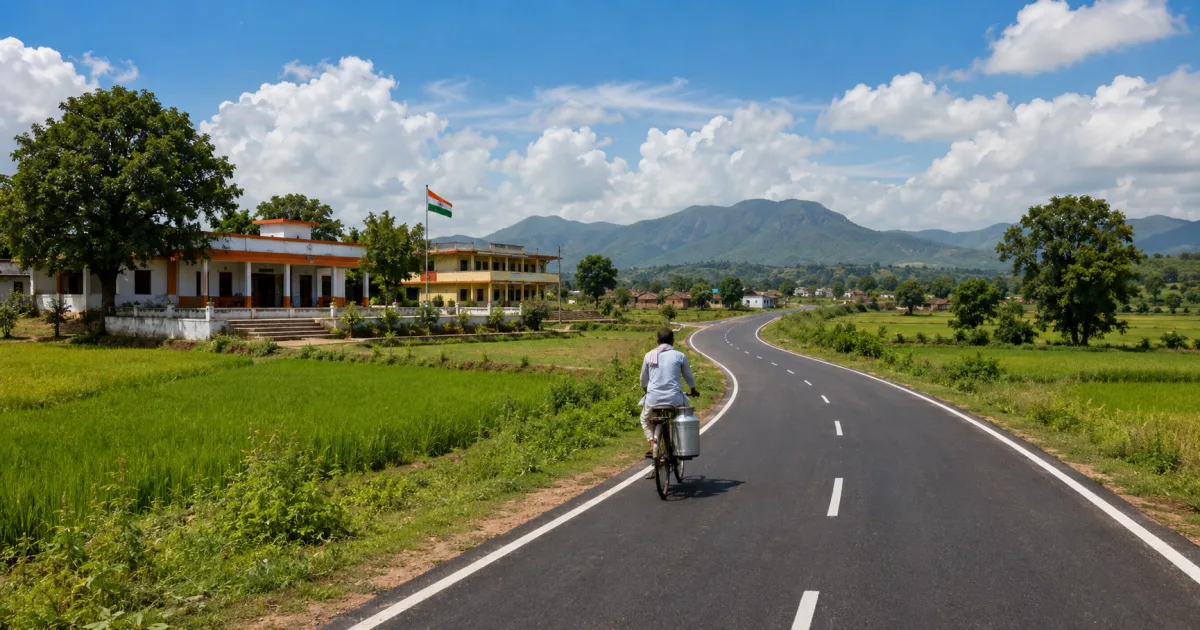
Table of Contents ▾
PMGSY-III Extended to March 2028 — ₹83,977 Crore Outlay, 161 Long-Span Bridges Approved
Quick summary. The Union Cabinet has approved continuation of Pradhan Mantri Gram Sadak Yojana-III (PMGSY-III) beyond March 2025 up to March 2028, with a revised outlay of ₹83,977 crore (up from the original ₹80,250 crore). Roads and bridges in plain areas and roads in hilly regions must be completed by March 2028; bridges in hilly areas get an extended deadline up to March 2029. The Cabinet also cleared 161 long-span bridges costing ₹961 crore, aligned with already-approved road projects. PMGSY-III consolidates rural roads into a stronger through-route network, connecting habitations to Gramin Agricultural Markets (GrAMs), higher secondary schools and hospitals.
PMGSY is the Government of India’s flagship rural connectivity programme, launched by Prime Minister Atal Bihari Vajpayee in 2000. It moved from new-connectivity (PMGSY-I) to upgradation of existing rural roads (PMGSY-II), and then in 2019 to consolidation under PMGSY-III — repairing and upgrading the strategic “through-routes and major rural links” that connect villages to the wider economy. The April 2026 extension is the second timeline extension PMGSY-III has received, with the funding pool topped up to keep pace with material cost inflation.
🎯 What changed in this extension
- Timeline: Extended from March 2025 → March 2028 (roads + plain-area bridges); hilly bridges till March 2029.
- Outlay: Revised upward from ₹80,250 crore → ₹83,977 crore — an addition of ₹3,727 crore to absorb input-cost escalation.
- 161 long-span bridges (LSBs) costing ₹961 crore approved separately, linked to already-sanctioned PMGSY-III road alignments.
- Same scope: focus remains on consolidation of existing rural roads into a coherent through-route network — not opening up new connectivity (that has shifted to PMGSY-IV, announced in Budget 2025).
📊 PMGSY-III at a glance
| Detail | Information |
|---|---|
| Scheme | Pradhan Mantri Gram Sadak Yojana-III (PMGSY-III) |
| Ministry | Ministry of Rural Development |
| Launched | 2019 |
| Original outlay | ₹80,250 crore |
| Revised outlay (April 2026) | ₹83,977 crore |
| Completion deadline — roads + plain bridges | March 2028 |
| Completion deadline — hilly bridges | March 2029 |
| Fund sharing pattern | 60:40 (Centre:State) for plains; 90:10 for NE & Himalayan states |
| Implementing agency at state level | State Rural Road Development Agencies (SRRDAs) |
| Technical supervision | National Rural Infrastructure Development Agency (NRIDA) |
| Quality monitoring | National Quality Monitors (NQMs) + State Quality Monitors (SQMs) |
💡 What PMGSY-III actually builds
Unlike PMGSY-I (new connectivity) and PMGSY-II (upgradation), PMGSY-III consolidates — it picks the highest-traffic rural roads and bridges in a district and brings them to a higher engineering standard. The selection logic favours alignments that:
- Connect habitations to “Rurban” growth centres under SPMRM.
- Feed Gramin Agricultural Markets (GrAMs) so that farm produce can move to mandis on all-weather roads.
- Connect higher secondary schools and hospitals — the two anchor public services that often define a village’s quality of life.
- Link to State Highways / National Highways at strategic junctions.
🔔 What’s not in PMGSY-III: Brand-new connectivity for unconnected habitations is now handled under PMGSY-IV (announced in Budget 2025). PMGSY-III only upgrades and consolidates existing rural road infrastructure.
🛠️ For a habitation / Panchayat: how a road gets selected
PMGSY does not accept individual citizen “applications” — it is a state-driven planning programme. The selection workflow:
- District Rural Roads Plan (DRRP) is prepared by the State PWD/Rural Engineering Department, listing all rural roads.
- The Core Network is identified — the strategic subset of roads needed to connect every habitation through the shortest economic path.
- State Rural Road Development Agency (SRRDA) prioritises alignments under PMGSY-III based on traffic, GrAM/school/hospital connectivity, and condition of existing road.
- Detailed Project Report (DPR) is prepared, tendered and executed by the state — with central funding flowing through the SRRDA bank account.
- Quality is audited by independent National Quality Monitors (NQMs) at three stages: ongoing, completed, and post-defects-liability.
If your habitation’s road is in poor condition and is part of the Core Network, the right channel to raise it is through the Block Development Officer (BDO) or Zilla Parishad, who feeds the State PWD’s annual proposal pipeline.
Educational Qualification
Age Limit (As on {date})
to Years
Other Requirements
- Nationality: Indian Citizen
🌉 The 161 long-span bridges
The Cabinet additionally approved 161 long-span bridges costing ₹961 crore under the same notification. These are bridges where the main span exceeds 25 metres — typically required at major river crossings or deep ravines in hilly terrain. LSBs are technically demanding and were a long-standing bottleneck under earlier PMGSY phases because they exceeded the cost-per-km caps of the regular programme. The 2026 approval rolls LSBs into the PMGSY-III framework with their own ringfenced budget, ensuring already-built approach roads on either side don’t dead-end at an unbridged river.