8th Pay Commission ToR Approved: Justice Desai to Head Panel, Report in 18 Months
Union Cabinet has approved the Terms of Reference of the 8th Central Pay Commission. Justice Ranjana Prakash Desai will chair the panel, with a report due in 18 months and implementation backdated to 1 January 2026. Members, fitment factor expectations and what changes for 50 lakh employees + 68 lakh pensioners.


Table of Contents ▾
8th Pay Commission ToR Approved: Justice Desai to Head Panel, Report in 18 Months
News flash. The Union Cabinet has approved the Terms of Reference (ToR) of the 8th Central Pay Commission (8th CPC), chaired by Justice Ranjana Prakash Desai (retired Supreme Court judge). The panel has 18 months to submit its report, and the revised pay, allowances and pension structure will be implemented with effect from 1 January 2026 — meaning eligible employees and pensioners will receive arrears once notified. About 50.46 lakh central government employees and 68.27 lakh pensioners stand to benefit.
In a long-awaited development, the Government of India has notified the constitution and Terms of Reference of the 8th Central Pay Commission. The Commission was formally constituted by Gazette Notification dated 3 November 2025, with the Cabinet later clearing the detailed ToR. It is tasked with reviewing pay, allowances, pension and service conditions of central government employees, autonomous bodies, all-India service officers, and members of the armed forces.
The previous pay commission — the 7th CPC — submitted its report in November 2015 and was implemented from 1 January 2016, meaning the standard 10-year revision cycle aligns with 1 January 2026 as the next effective date. The Commission’s report itself, however, is expected only in the second half of 2027 — so arrears for FY 2026-27 will accrue and be paid retrospectively.
Key highlights
- Chairperson: Justice Ranjana Prakash Desai (retired SC judge)
- Part-Time Member: Prof. Pulak Ghosh
- Member-Secretary: Shri Pankaj Jain
- Effective date of new pay scale: 1 January 2026 (backdated)
- Report due in: 18 months from constitution → expected mid-2027
- Who benefits: ~50.46 lakh central employees + ~68.27 lakh pensioners
Why this update matters
For more than a decade, central government salaries and pensions have been governed by the 7th CPC pay matrix. With cost of living, AICPI-IW inflation, and private-sector benchmarks having moved significantly since 2016, employee federations have been pressing for a fresh revision. The ToR notification is the first concrete step — it sets the rules under which the Commission will examine pay structure, allowances, retirement benefits and the new fitment factor that will translate today’s basic pay into tomorrow’s.
Action required. Employees do not need to “apply” anywhere. Once the Commission submits its report and the Cabinet accepts it, your DDO / pay-bill unit will revise your basic pay automatically. Until then, your salary continues to be governed by the 7th CPC pay matrix plus the current DA of 60%.
What the Terms of Reference cover
The Cabinet-approved ToR direct the Commission to examine and recommend on:
| Area | What the 8th CPC will review |
|---|---|
| Pay structure | Basic pay matrix, fitment factor, levels and grade pay |
| Allowances | HRA, TA, CCA, transport, deputation, risk and hardship allowances |
| Pension | Existing pension formulas under NPS, OPS (for legacy employees), family pension |
| Service conditions | Leave, promotion norms, performance-linked pay |
| Fiscal context | Budget impact, alignment with public/private benchmarks, fiscal prudence |
| Coverage | Central govt employees (civilian + military), All-India Services, autonomous bodies |
The pensioners’ eligibility for pay-revision-linked pension hike is explicitly included in the ToR — settling earlier ambiguity from the 7th CPC era.
Fitment factor — what to expect
The fitment factor is the multiplier applied to the existing basic pay to arrive at the new basic pay under the next CPC. The 7th CPC used a factor of 2.57.
| Source | Expected fitment factor | Implied salary hike |
|---|---|---|
| Kotak Institutional Equities (research note) | 1.8 – 2.46 | 13–30% |
| Ambit Capital (research note) | 1.8 – 2.46 | 13–30% |
| Employee unions (NC-JCM demand) | 2.86 – 3.25 | 40–60% |
The Commission itself has not commented on the fitment factor — these are external estimates and union demands respectively. The final number will be decided in the 8th CPC report.
Timeline of events
Important Dates
- 3 November 2025 — 8th CPC constituted via Gazette Notification.
- March 2026 — MyGov 18-point questionnaire closed (31 March 2026) for stakeholder feedback.
- April 2026 — Cabinet approves detailed Terms of Reference.
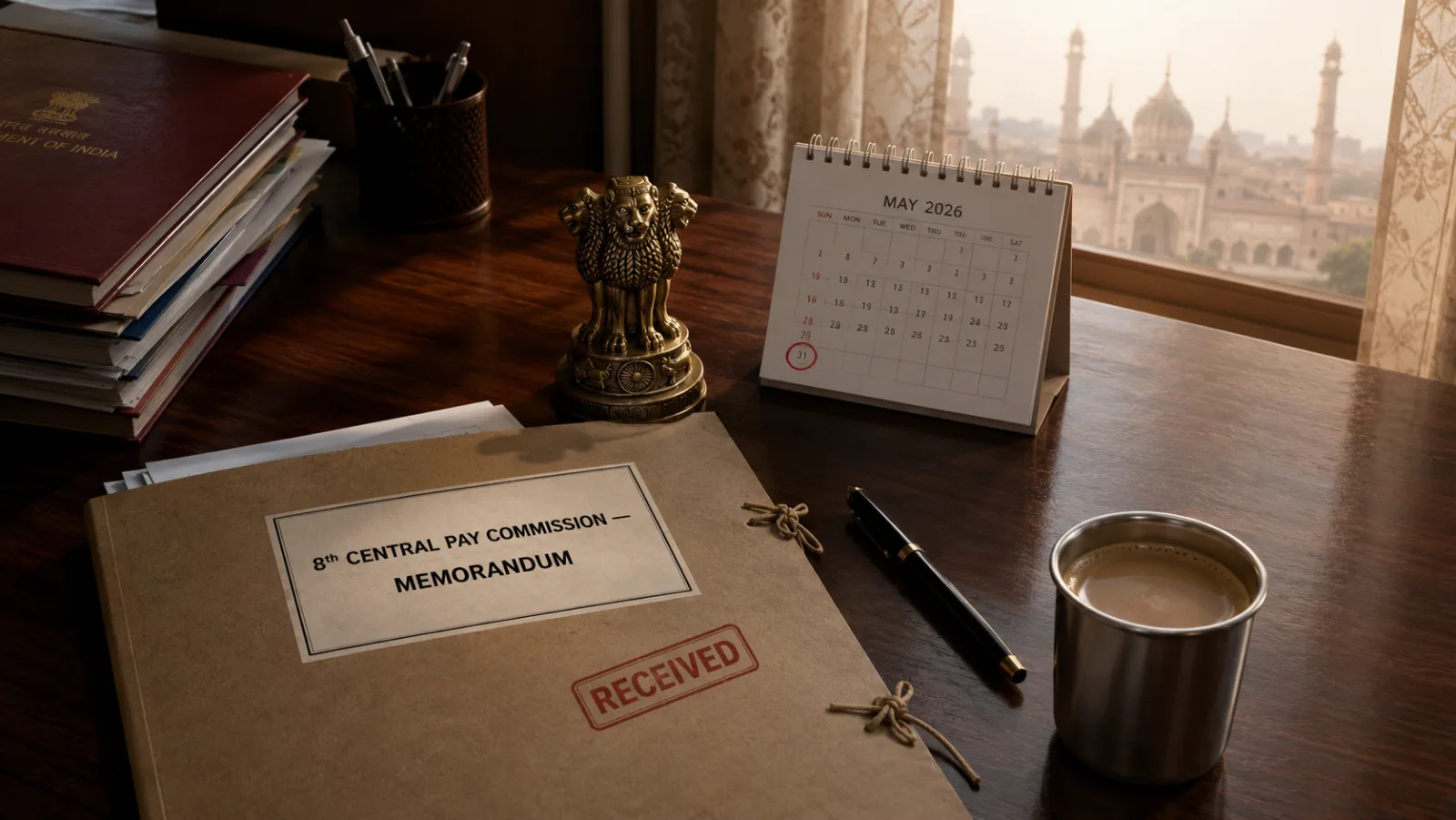
- 31 May 2026 — Extended deadline for NC-JCM (employee federation) to submit memorandum.
- Mid-2027 (expected) — Commission submits final report to government.
- 2027-28 (expected) — Cabinet accepts recommendations; revised pay notified; arrears paid from 1 January 2026.
What happens next
The Commission will hold consultations with employee federations, ministries, state governments and subject experts over the next 12-15 months. NC-JCM, the apex consultative body of central government employees, has been given until 31 May 2026 to submit its consolidated memorandum. Once recommendations are submitted, the Cabinet typically takes 3–6 months to accept and notify them. Expect formal salary revisions to land in pay slips sometime in late 2027 or early 2028, with arrears for the full intervening period.
Frequently asked questions
1. Who is the chairperson of the 8th Pay Commission?
2. When will the 8th CPC report be submitted?
3. From which date will the 8th CPC pay scales apply?
4. Who is covered by the 8th Pay Commission?
5. What is the expected fitment factor under 8th CPC?
6. Does the 8th CPC apply to pensioners?
Official references
Disclaimer. SarkariBaba is an independent information publisher and is not affiliated with any government department. This article reflects publicly available information as of the published date. Estimates of fitment factor and salary hike are external projections by research firms or union demands, not official figures. Always verify against 8cpc.gov.in and PIB releases before acting.