
Union Budget 2026: New Income Tax Slabs Retained, ₹12 Lakh Tax-Free Continues
Union Budget 2026 retains the new tax regime slabs introduced in Budget 2025 — income up to ₹12 lakh remains tax-free for salaried (with standard deduction). Slabs, rebate, key compliance changes and what taxpayers should do for FY 2026-27.
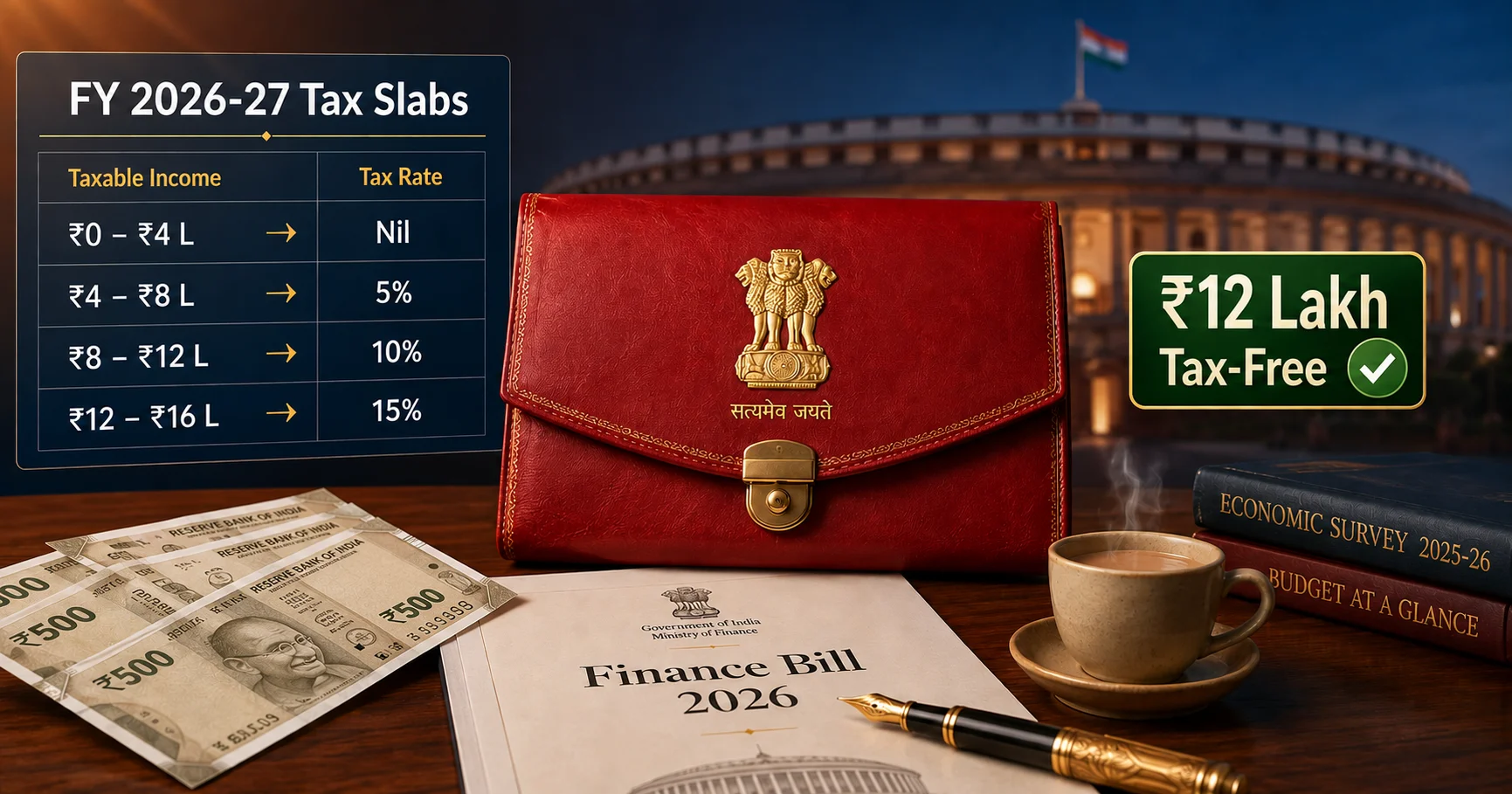
Table of Contents ▾
Union Budget 2026: New Income Tax Slabs Retained, ₹12 Lakh Tax-Free Continues
News brief. Finance Minister Nirmala Sitharaman presented the Union Budget 2026-27 on 1 February 2026. The government did not change income tax slab rates under either the new or the old regime — the structure introduced in Budget 2025 carries forward intact for FY 2026-27. Salaried taxpayers earning up to ₹12 lakh continue to pay zero income tax (after the ₹75,000 standard deduction and Section 87A rebate). The new Income-tax Act, 2025 comes into force from 1 April 2026, replacing the 1961 Act with a substantially simpler text. Several compliance reforms were announced — most notably, the revised return deadline extended from 31 December to 31 March of the assessment year.
The 2026-27 Budget was billed as a “consolidation budget” — the government’s stated aim was to let last year’s reforms (the new regime slab restructuring, the ₹12 lakh exemption threshold, and the ₹75,000 standard deduction) settle in, rather than introduce another wave of slab changes. Personal-tax watchers had widely expected at most marginal tweaks to the ₹12 lakh rebate cap; the FM kept it unchanged.
For most salaried taxpayers and small-business owners, nothing about your monthly TDS or your annual ITR computation will change for FY 2026-27 compared to FY 2025-26. What does change is the rule book itself: the Income-tax Act, 2025 — passed in 2025 — comes into force on 1 April 2026, simplifying the language, consolidating sections and reducing the Act from 47 chapters to 23.
New tax regime slabs (FY 2026-27 / AY 2027-28) — unchanged
| Income range (₹) | Tax rate |
|---|---|
| 0 – 4,00,000 | Nil |
| 4,00,001 – 8,00,000 | 5% |
| 8,00,001 – 12,00,000 | 10% |
| 12,00,001 – 16,00,000 | 15% |
| 16,00,001 – 20,00,000 | 20% |
| 20,00,001 – 24,00,000 | 25% |
| Above 24,00,000 | 30% |
Section 87A rebate — for resident individuals under the new regime, the rebate continues at up to ₹60,000, making the effective tax-free income ₹12 lakh for non-salaried and ₹12.75 lakh for salaried (after the ₹75,000 standard deduction). The marginal-relief mechanism applies just above ₹12 lakh.
Old regime slabs (FY 2026-27) — also unchanged
| Income range (₹) | Tax rate |
|---|---|
| 0 – 2,50,000 | Nil |
| 2,50,001 – 5,00,000 | 5% |
| 5,00,001 – 10,00,000 | 20% |
| Above 10,00,000 | 30% |
Resident senior citizens (60–80) get a basic exemption of ₹3 lakh, super-senior citizens (80+) of ₹5 lakh under the old regime. The Section 87A rebate under the old regime stays at up to ₹12,500 (effective tax-free ceiling of ₹5 lakh), unchanged for years now.
What did change — key compliance reforms
While slab rates are static, Budget 2026 announced a basket of compliance and procedural reforms:
- Revised return deadline extended: Deadline for filing a revised return moves from 31 December to 31 March of the assessment year — giving taxpayers three additional months to correct disclosures or report missed income.
- Income-tax Act, 2025 — effective 1 April 2026: The new code becomes operational from the start of FY 2026-27. Crucially, the new Act introduces no new tax liability over and above what already exists — it is a simplification, not a re-rating.
- Faceless appeal expansion: The faceless framework now extends to a wider category of CIT(A) appeals; physical hearings only on request.
- Litigation reduction monetary thresholds raised: Department-side appeals to higher forums (ITAT/HC/SC) require higher tax-effect thresholds, reducing taxpayer-side burden of contested low-value matters.
- Updated Return (ITR-U) window expanded: The window to file an updated return has been extended from 24 months to 48 months from the end of the relevant assessment year, with a stepped additional-tax slab.
- TDS / TCS rationalisation: Several TDS rates were aligned (e.g., reduced rate categories merged), simplifying employer and platform compliance.
What stays exactly the same
- Slab rates under both regimes (no change).
- The ₹12 lakh tax-free ceiling for new-regime resident individuals (with rebate).
- The ₹75,000 standard deduction (new regime) / ₹50,000 (old regime).
- The deduction structure under Sections 80C, 80D, 80CCD(1B), 80CCD(2) — still old-regime only, except 80CCD(2) which works under both regimes.
- The default tax regime — the new tax regime remains the default unless you actively opt for the old regime via Form 10-IEA at the time of filing.
What this means for taxpayers
| Profile | Impact of Budget 2026 |
|---|---|
| Salaried earning ≤ ₹12.75 lakh (under new regime) | Zero tax; nothing to do; new regime continues to be the default |
| Salaried earning ₹15–₹25 lakh | No change in liability; continue to compare both regimes annually before filing |
| Self-employed / professionals | No change in slabs; benefit from the longer revised-return window |
| Senior citizens drawing pension | Old regime usually still beats new for those with significant 80C + 80D + medical claims; verify with your CA |
| Investors with capital gains | No new STCG/LTCG rate changes in Budget 2026; the 12.5% LTCG / 20% STCG (equity) framework set in Budget 2024 remains |
| Crypto / VDA holders | 30% flat rate + 1% TDS regime continues; no new concession |
Quick worked example
Salary ₹15 lakh (FY 2026-27, new regime, no other income):
- Standard deduction: ₹75,000
- Net taxable: ₹14,25,000
- Tax (slab-wise):
- 0–4 lakh → ₹0
- 4–8 lakh → ₹20,000
- 8–12 lakh → ₹40,000
- 12–14.25 lakh → ₹33,750
- Total tax: ₹93,750
- Plus 4% cess: ₹3,750
- Final tax payable: ₹97,500
(Compare with FY 2025-26 — the figure is identical, since slabs and rebate haven’t moved.)
Frequently asked questions
1. Did Union Budget 2026 change income tax slabs?
2. What is the tax-free income limit in 2026?
3. Is the new tax regime still the default in 2026?
4. When does the new Income-tax Act 2025 come into effect?
5. What is the new revised return deadline announced in Budget 2026?
6. Will my monthly TDS change from April 2026?
7. Can I still claim 80C, 80D and Section 80CCD(1B) deductions in 2026?
8. What was the Section 87A rebate change in Budget 2026?
Official links
Disclaimer. SarkariBaba is an independent news publisher and does not provide investment, tax or legal advice. Tax provisions are subject to change through subsequent notifications, circulars or Finance Bill amendments during passage in Parliament. Always verify your specific liability with a qualified Chartered Accountant or at incometax.gov.in before filing your return.