
NPS 2026 — How to Open National Pension System Account Online & Save ₹2 Lakh Tax
Open an NPS account online in 15 minutes via eNPS. Section 80CCD(1B) extra ₹50,000 deduction over and above 80C, Tier I vs Tier II, fund managers, withdrawal & annuity rules — full 2026 guide.
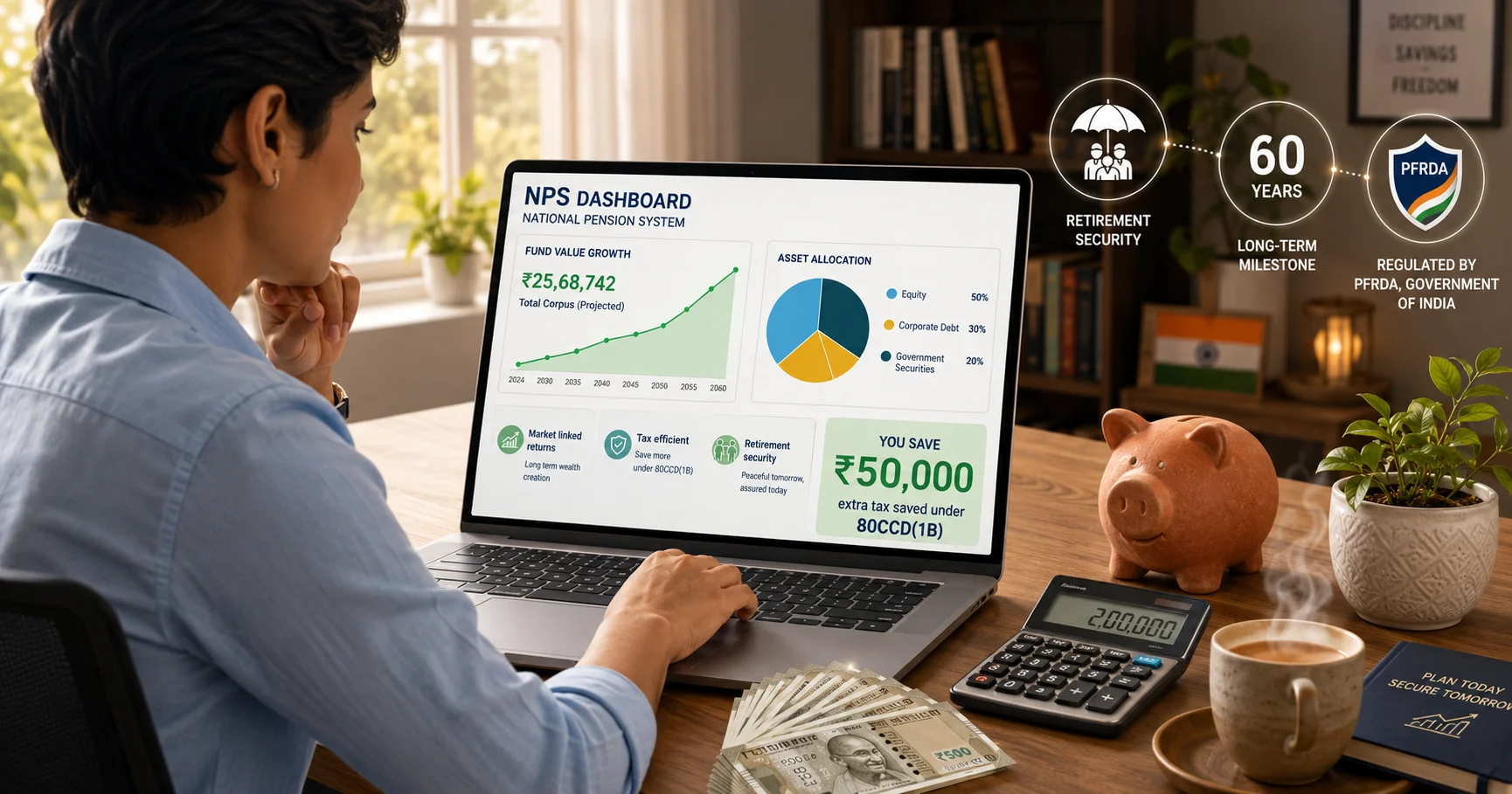
Table of Contents ▾
- Who is eligible?
- Tier I vs Tier II — pick the right account
- Tax benefits (the real reason to open NPS)
- Documents required
- How to open an NPS account online
- Choosing fund manager and allocation — a sane default
- Premature exit and partial withdrawal
- Frequently asked questions
- Latest updates (2026)
- Official links
Quick summary. National Pension System (NPS) is a voluntary, market-linked retirement-savings scheme regulated by PFRDA. It offers two account tiers — Tier I (locked till 60, retirement-only, mandatory) and Tier II (no lock-in, optional, like a flexible savings wallet). Tax benefits: ₹1.5 lakh under 80C + extra ₹50,000 under 80CCD(1B) + employer contribution up to 10% of basic under 80CCD(2) — totalling deductions well above ₹2 lakh for salaried individuals. Open online in 15 minutes via enps.nsdl.com or enps.nps-proteantech.in using Aadhaar / PAN. Eligibility: any Indian citizen / NRI aged 18–85.
NPS is the central pillar of India’s modern retirement architecture. Designed by PFRDA in 2004 (initially for central government recruits, opened to all citizens in 2009), the scheme combines low costs, tax efficiency, equity-debt diversification and a regulated annuity at exit. Where EPF is automatic for the salaried, and PPF is fixed-rate, NPS is the only retirement vehicle in India that lets you build a market-linked corpus while taking the highest tax deduction available on any pension product — the additional ₹50,000 under Section 80CCD(1B) is exclusive to NPS.
The 2026 framework — under the new tax regime — has tilted further in NPS’s favour: Section 80CCD(2) employer-contribution deduction is now available even in the new regime (where 80C and 80CCD(1B) are not), making NPS effectively the only meaningful tax-saver left for new-regime salaried earners.
NPS at a glance
| Detail | Information |
|---|---|
| Regulator | PFRDA (Pension Fund Regulatory and Development Authority) |
| Launched | 2004 (central govt staff); 1 May 2009 (all citizens) |
| Account types | Tier I (mandatory, locked) + Tier II (optional, flexible) |
| Eligibility | Indian citizen / NRI / OCI, aged 18–85 |
| Min contribution Tier I | ₹500 per contribution; ₹1,000 per year |
| Min contribution Tier II | ₹250 per contribution; no annual minimum |
| Asset classes | E (equity), C (corporate debt), G (govt securities), A (alternatives) |
| Tax benefit Section 80C | Up to ₹1,50,000 (combined with other 80C items) |
| Tax benefit Section 80CCD(1B) | Additional ₹50,000 (NPS-exclusive) |
| Tax benefit Section 80CCD(2) | Up to 10% of basic salary (14% for govt employees) — over and above 80C/80CCD(1B) |
| Exit age | 60 (or after 3 years if premature) |
| Annuity required at exit | Minimum 40% of corpus must buy annuity |
| Apply mode | Online via eNPS portal or any PoP bank |
| Time to open | 15 minutes (Aadhaar OTP route) |
Who is eligible?
Educational Qualification
Not applicable
Age Limit (As on Date of registration)
18 to 85 Years
Other Requirements
- Nationality: Indian citizen, NRI, or OCI
- Must have a valid PAN — for KYC and contribution tracking
- Aadhaar is required for the eNPS Aadhaar-OTP route (skipping it forces a wet-signature flow via PoP)
- Bank account with internet banking — for online contributions, lump-sum and SIP-style monthly transfers
- Cannot be a person of unsound mind or an undischarged insolvent (standard contracts disqualifier)
- HUFs are NOT eligible — NPS is for individuals only
In simple terms. Any Indian adult (18–85) with PAN + bank account can open NPS in 15 minutes online. NRIs and OCIs are welcome — the only difference is that NRI contributions must come from an NRO/NRE/FCNR account.
Tier I vs Tier II — pick the right account
| Feature | Tier I | Tier II |
|---|---|---|
| Mandatory? | Yes, the primary pension account | No, can be opened only after Tier I is active |
| Lock-in | Until age 60 (with limited partial withdrawals) | None — withdraw anytime |
| Min annual contribution | ₹1,000 | None |
| Tax deduction on contribution | Yes — 80C + 80CCD(1B) + 80CCD(2) | No (except for central govt staff with 3-yr lock-in under 80C) |
| Tax on withdrawal | 60% lump-sum tax-free at exit; 40% goes to annuity (annuity income taxable) | Capital gains tax as per holding period and asset mix |
| Use case | Retirement corpus | Flexible long-term savings; substitute for mutual funds for cost-conscious investors |
Strategy tip. Most individuals open Tier I first for the tax break, then add Tier II only if they want a low-cost, flexible savings vehicle alongside.
Tax benefits (the real reason to open NPS)
Old tax regime — full stack available
| Section | Benefit | Who |
|---|---|---|
| 80C | ₹1,50,000 (shared with PF, PPF, ELSS, life insurance, etc.) | Self contribution to Tier I |
| 80CCD(1B) | Additional ₹50,000 — NPS only | Self contribution to Tier I, over and above 80C |
| 80CCD(2) | Up to 10% of basic + DA (14% for central govt) | Employer’s contribution to your NPS — in addition to 80C and 80CCD(1B) |
A salaried person earning ₹15 lakh basic with employer contributing 10% can stack a deduction of: ₹1,50,000 (80C) + ₹50,000 (80CCD(1B)) + ₹1,50,000 (80CCD(2)) = ₹3,50,000 total.
New tax regime — only employer contribution
Under the default new regime in 2026, deductions under 80C and 80CCD(1B) are not available. 80CCD(2) is still allowed, making NPS one of the very few tax-efficient retirement levers left for new-regime salaried earners. If your employer doesn’t already contribute to NPS, ask HR to set it up under your CTC.
At maturity (age 60)
- 60% of the accumulated corpus can be withdrawn as a tax-free lump sum.
- 40% must be used to buy an annuity from a PFRDA-empanelled life insurer — annuity income is taxed at slab rates as pension.
Documents required
While filling online form
- PAN card (mandatory)
- Aadhaar card linked to active mobile number (for OTP-based KYC)
- Bank account passbook / cancelled cheque (for SIP and exit credit)
- Recent passport-size photograph (digital upload, JPEG, <50 KB)
- Active mobile number + email ID
PRAN = Permanent Retirement Account Number, your 12-digit lifelong NPS ID. Issued instantly on the Aadhaar route; takes 7–10 days on the wet-signature route.
How to open an NPS account online
Option A — eNPS (Aadhaar OTP route) — recommended
- Go to enps.nsdl.com (NSDL CRA) or enps.nps-proteantech.in (Protean CRA) — both serve the same purpose; pick one CRA and stay with it.
- Click Registration → New Registration → Individual Subscriber → Aadhaar offline e-KYC or Aadhaar OTP.
- Enter Aadhaar + virtual ID, receive OTP, verify.
- Personal details, address, employment, bank account, nominee — all auto-populated from Aadhaar where possible.
- Choose Tier I only (most users) or Tier I + Tier II.
- Choose your fund manager (HDFC Pension, ICICI Prudential Pension, SBI Pension, UTI Retirement Solutions, LIC Pension, Aditya Birla Sun Life Pension, Kotak Mahindra Pension, Tata Pension, Max Life Pension, Axis Pension, DSP Pension).
- Choose Asset allocation: Auto choice (lifecycle, age-based glide path) or Active choice (you set E/C/G/A weights, max 75% to E up to age 50).
- Upload photo + signature (JPEG, under 50 KB each).
- Make the first contribution (minimum ₹500). Pay via internet banking / UPI / card.
- e-sign with Aadhaar OTP — your PRAN is issued instantly. PRAN card PDF is mailed.
Option B — Through a PoP (bank or financial institution)
If you prefer face-to-face, walk into any PoP-SP (most major banks: SBI, HDFC, ICICI, Axis, Kotak, BoB, Canara, PNB, etc.). Carry PAN + Aadhaar + cancelled cheque + photo. The branch official fills the form and submits to the CRA. PRAN comes by post in 10–14 days.
⏰ Last Date: Open (no last date — voluntary, lifelong)
Open NPS via eNPSClicking this button will take you to the official government portal.
Choosing fund manager and allocation — a sane default
If this is your first time, the simplest robust setup is:
- CRA: pick whichever — NSDL and Protean charge near-identical fees.
- Pension fund manager: HDFC Pension, ICICI Prudential or SBI Pension are consistently in the top quartile across 5- and 10-year returns. Past returns are not future returns; what matters more is staying invested.
- Allocation: Auto choice — Aggressive Lifecycle (LC75). Equity exposure starts at 75% (up to age 35), tapers automatically as you age toward 60. You don’t need to rebalance manually.
- Active choice: only if you actively track markets. Cap E at 75% (PFRDA limit till age 50, then steps down).
You can switch fund manager once a year, and switch allocation four times a year — both at zero cost and no tax impact.
Premature exit and partial withdrawal
| Event | Rule |
|---|---|
| Partial withdrawal (Tier I) | After 3 years of subscription; max 25% of own contribution; only for housing, child education/marriage, critical illness, disability, skill upgrade, or starting a venture; up to 3 times in entire NPS life |
| Premature exit (Tier I) before 60 | After 5 years; 80% goes to annuity, 20% lump-sum |
| Exit at superannuation (60+) | 60% lump-sum tax-free; 40% annuity (mandatory) |
| Death of subscriber | 100% of corpus paid to nominee tax-free; nominee can opt for annuity instead |
| Tier II withdrawal | Anytime, no restriction (capital gains apply) |
Frequently asked questions
1. What is the additional ₹50,000 NPS tax benefit under 80CCD(1B)?
2. Tier I or Tier II — which should I open first?
3. What is the minimum amount to open and maintain NPS?
4. Can NRIs open an NPS account?
5. What happens to NPS if I change jobs?
6. Is NPS better than PPF or EPF?
7. Is the NPS lump sum at age 60 tax-free?
8. Can I withdraw NPS money before age 60?
9. Which is the best NPS fund manager in 2026?
10. Can I have both EPF and NPS?
Latest updates (2026)
- 80CCD(2) under new regime: From AY 2024-25 onwards, the employer-contribution deduction continues to be available under the new tax regime — 14% of basic for government employees, 10% for private sector. This makes NPS the most efficient remaining tax-saver for new-regime salaried individuals.
- Systematic Lump-sum Withdrawal (SLW): Subscribers retiring at 60 can now phase the 60% lump-sum across up to 75 years of age (annual / quarterly / monthly tranches), keeping it invested in the meantime — extending tax-deferral benefits.
- D-Remit / Direct contribution: Same-day investment value (NAV) is now applied if contributions hit the trustee bank by 9:30 AM on a working day, via the D-Remit virtual account.
- Combined CSRF / Aadhaar e-KYC: A single unified registration form has replaced the older multi-page CSRF, cutting eNPS onboarding time to under 12 minutes for first-time users with Aadhaar.
Official links
Disclaimer. SarkariBaba is an independent information publisher and does not provide investment, tax or legal advice. NPS is a market-linked product; returns are not guaranteed. Tax provisions change with the Finance Act each year; verify current limits with your CA or at incometax.gov.in before filing. Always confirm fund-manager performance and exit rules at npstrust.org.in.